Industrial Racking & Storage Solutions Showcase
High-capacity structural steel systems configured for raw material handling, irregular profile storage, and automated logistics hubs.
Executive Evaluation of Structural Cantilever Storage Systems
Optimizing linear load bearing, moment resistance, and operational safety for long-format industrial inventory.
In modern industrial warehousing, managing non-standard, long-format, and heavy linear inventory—such as structural steel beams, extruded aluminum profiles, PVC piping, timber bundles, and sheet metal—presents a fundamental mechanical challenge to conventional vertical pallet racks. Standard pallet racking structures rely on front upright columns connected by horizontal beams, creating enclosed bays that physically obstruct continuous horizontal loading. Attempting to store 6-meter or 12-meter structural profiles within traditional frame configurations leads to severe load concentration, severe operational inefficiencies, and unacceptable safety hazards.
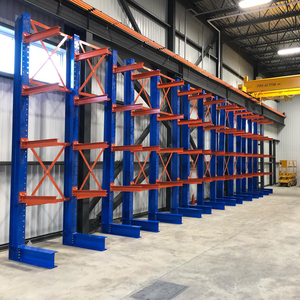
Cantilever racking systems solve this spatial constraint by eliminating front vertical columns. Constructed with central structural columns connected to a robust floor-anchored base, cantilever systems utilize freestanding load-bearing arms projecting horizontally outward. This creates an uninhibited, continuous linear storage platform accessible across the entire length of the rack structure. However, the elimination of front vertical supports shifts structural forces from simple axial compression to complex combined bending, torsion, and eccentric loading dynamics.
When selecting top cantilever racking suppliers and exporters, structural verification must extend beyond simple gross weight metrics. Calculating structural stability requires calculating the maximum allowable arm deflection ($\delta$) defined under ANSI MH16.3 and FEM 10.2.09 rules. The deflection limit ratio for heavy industrial cantilever arms is typically bounded by $\delta \le L / 300$, where $L$ represents the projecting arm length. Overloading or improper load positioning introduces severe rotational shear at the column-to-arm interface, demanding precision-milled connection locks and high-tensile structural steel profiles (such as hot-rolled I-beams Q355B or cold-formed heavy C-channels).
Moment Resistance Dynamics
Cantilever columns absorb extreme bending moments generated by eccentric arm loads. Column bases feature heavy-gauge gusset plates welded to structural base channels, secured to concrete foundations using chemically anchored dynamic expansion bolts.
Articulated Arm Safety Connectors
Advanced cantilever designs incorporate self-locking, taper-pinned or wedge-action arm connectors. If hit by a lifting forklift during retrieval, articulated arms swing upward slightly without bending structural steel or dislodging column joints.
Torsional & Horizontal Bracing
Heavy-duty structural bracing towers connect adjacent vertical columns with heavy-gauge diagonal cross-bracing. This structural frame prevents longitudinal racking movement and eliminates torsional twisting under unbalanced loading patterns.
Engineering Comparison: Structural Hot-Rolled vs. Cold-Formed Cantilever Systems
Global procurement teams must evaluate material choices based on operational intensity, material weight, and environmental exposure. Cantilever racking systems are broadly divided into hot-rolled structural steel (I-beams and H-sections) and cold-formed steel (roll-formed sheet metal profiles). The table below highlights the engineering metrics that dictate component selection:
| Performance / Feature Metric | Structural Hot-Rolled Cantilever (I-Beam) | Cold-Formed Roll-Formed Cantilever | Impact on Procurement Cost & Longevity |
|---|---|---|---|
| Steel Grade Standard | Q355B / ASTM A572 Grade 50 | Q235B / ASTM A1011 SS Grade 33 | Higher yield strength (355 MPa) permits slimmer profiles with superior deflection resistance. |
| Per-Arm Load Capacity Range | 800 kg to 3,500+ kg per arm | 200 kg to 800 kg per arm | Hot-rolled systems suit raw steel coils, heavy pipe, and structural lumber stacks. |
| Impact Resistance Factor | Extremely High (Solid Steel Flanges) | Moderate (Subject to local bucking) | Hot-rolled steel absorbs direct forklift impact with minimal structural yield loss. |
| Adjustability Mechanism | Bolted Connection (100mm / 150mm Pitch) | Wedge & Pin Plug-in (50mm / 75mm Pitch) | Cold-formed systems offer faster vertical arm repositioning for light multi-SKU yards. |
| Surface Protection Options | Hot-Dip Galvanized (ISO 1461) / Powder Coat | Electrostatic Powder Coating (Epoxy Polyester) | Hot-dip galvanizing protects outdoor pipe yards against coastal corrosion for 25+ years. |
Future Procurement Trends in Cantilever & Industrial Racking
Key shifts driving global procurement strategies across South America, Europe, North America, and APAC logistics corridors.
1. Integration with Autonomous Mobile Robots (AMRs) & Side-Loading AGVs
Traditional cantilever management relies heavily on manual side-loading forklifts, combi-trucks, or overhead cranes. However, top tier global logistics hubs are transitioning toward automated side-loading Guided Vehicles (AGVs). Procurement specifications now require absolute structural tolerance limits. Column perpendicularity must be maintained within strictly controlled limits ($\pm 2\text{ mm}$ total height deviation) to allow robotic optical sensors to align fork prongs beneath long goods without collision.
2. Compliance with Regional Regulatory Frameworks (ABNT NBR 15524 & NR-11)
Cross-border procurement demands localized regulatory engineering. For instance, importing storage systems into Latin American markets—specifically Brazil—requires strict compliance with ABNT NBR 15524 (Sistemas de armazenagem - Estruturas metálicas). Leading global manufacturers now deliver factory certified structural calculations, Portuguese load capacity plaques (Placas de Carga), and formal support for local engineer ART (Anotação de Responsabilidade Técnica) sign-offs.
3. Green Steel Sourcing & Decarbonized Environmental Product Declarations (EPD)
Multinational enterprise buyers are imposing strict Scope 3 carbon emission caps across supply chains. Consequently, purchasing decisions prioritize racking manufacturers operating electric arc furnace (EAF) steel lines and zero-VOC electrostatic powder painting facilities. Full EPD validation documenting low embodied carbon per metric ton of steel manufactured is rapidly becoming a mandatory tender prerequisite.
4. Modular Outdoor Cantilever Shelving with Integrated Weatherproofing Canopy
Industrial land acquisition costs have inflated indoor footprint expenditure. To compensate, operators are converting open outdoor yards into high-density long-goods storage hubs. Suppliers now engineer cantilever column tops with integrated structural steel trusses supporting pitched corrugated roofs, snow load ratings, and wind-shear bracing, effectively extending warehouse capacity without civil building permits.
Technological & Engineering Development Trends
How next-generation material science and digital twin monitoring are reshaping industrial rack safety.
The engineering evolution of heavy-duty industrial storage systems focuses on real-time structural health diagnostics, advanced metallurgical alloys, and intelligent space-optimization mechanics:
- IoT-Enabled Strain Gauge Load Monitoring: Wireless load sensors embedded at key column-base junctions and high-stress cantilever arms stream structural flex data to cloud monitoring dashboards. If uneven load placement or impact stress exceeds safety factors, automated alerts prevent catastrophic structural collapse.
- Zinc-Aluminum-Magnesium (ZAM) Alloy Coating: Replacing traditional hot-dip galvanizing in aggressive saline or chemical environments, ZAM coated steels offer self-healing edge corrosion protection, thinner coating thickness requirements, and superior scratch resistance during heavy steel profile placement.
- Telescopic Automatic Extension Arms: Specialized R&D units are developing hydraulic and mechanical push-out cantilever arms that extend automatically when picking thin sheet bundles or timber stacks, permitting standard overhead forklifts to service narrow-aisle long-goods racks.
- Seismic Dynamic Energy Dissipation Bases: In high seismic zones, cantilever column bases are integrated with friction-damped shear keys that absorb ground acceleration energy, protecting top-heavy cantilever racks carrying 10-ton stack loads from dynamic tipping.
BR Industrial Racking Ltda. — Enterprise Advantage
Delivering high-precision storage engineering, localized code compliance, and global logistics execution since 2005.
Established in 2005, BR Industrial Racking Ltda. operates as a premier global manufacturer and exporter specializing in heavy-duty selective pallet racking, drive-in systems, long-span shelving, industrial mezzanines, and custom cantilever solutions. Backed by a dedicated technical staff of over 120 senior engineers, production specialists, and quality control auditors, our annual export sales volume exceeds US$16 Million, serving major logistics hubs across South America, North America, Europe, and Asia.
Modern Production Base
Operating out of our manufacturing facility at No. 89, Yingzhou North Road, Haizhu District, Guangzhou 510320, China, our plant houses automated roll-forming lines, robotic welding stations, and automated powder coating chambers.
Precision PBR & Spec Design
We specialize in designing custom warehouse configurations adapted to regional unit-load standards, including 1,000 × 1,200 mm PBR pallets (Padrao Brasil), Euro-pallets, and oversized cantilever bundle profiles.
End-to-End Export Logistics
We provide complete container-packing protection (heavy-duty banding, steel corner protectors, moisture barriers) with direct shipping to major global ports including Santos, Paranaguá, Itajaí, and Rio de Janeiro under FOB/CIF terms.
Our manufacturing and quality management frameworks are certified under ISO 9001, carrying international compliance certificates including CE and Japanese Industrial Standards (JIS). Every cantilever column, arm bracket, and base plate undergoes rigorous non-destructive weld testing, coating thickness evaluation, and axial yield strength testing before shipment, providing full structural verification and load certificate support for regulatory workplace compliance (including Brazilian NR-11 and ABNT NBR 15524 audit standard requirements).
Frequently Asked Questions by Industrial Buyers
Addressing structural engineering, localized standard compliance, custom fabrication, and international delivery mechanics.