Featured Industrial Racking & Bulk Storage Solutions
Engineered for high-density storage, maximum structural rigidity, and seamless integration with standard PBR, Euro, and ISO pallet handling systems.
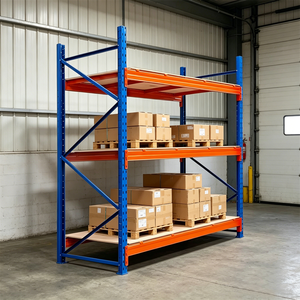
Powder Coated Heavy Duty Industrial Warehouse Storage Pallet Racking
- High-Yield Q235B Cold-Rolled Steel
- Electrostatic Epoxy Powder Coating
- 1,000 kg – 4,000 kg / Level Capacity
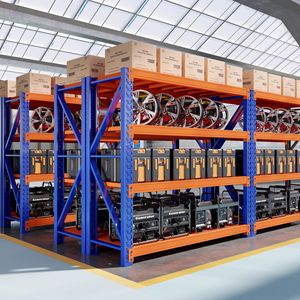
Boltless Adjustable Industrial Heavy Duty Steel Racking System (CE Certified)
- CE Certified Corrosion Protection
- Interlocking Step Beam Connections
- 50mm / 75mm Pitch Adjustability
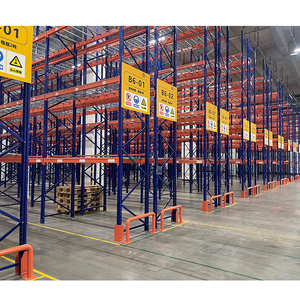
Industrial Storage Shelving System Heavy Duty Steel Pallet Rack
- Optimized Upright Frame Profile
- FEM 10.2.02 & RMI Standard Met
- Custom Beam Lengths & Depths
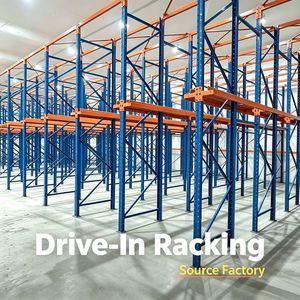
Drive-In Pallet Storage Racking System for Industrial Bulk SKU Storage
- 80%+ Floor Space Utilization
- Ideal for Cold Storage & Bulk FMCG
- LIFO Inventory Management Flow
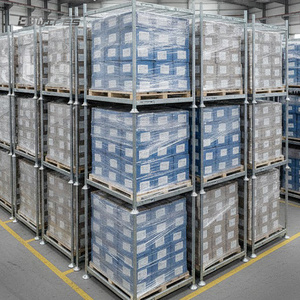
Sturdy Mild Steel Q235 Heavy Duty Detachable Stacking Post Pallet Rack
- Modular Detachable Post Rails
- Stackable up to 4–6 Tiers High
- Flexible Seasonal Warehouse Layout
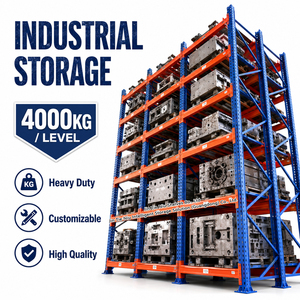
4000KG Ultra Heavy Duty Warehouse Rack Pallet System Beam Racking
- 4,000 kg Beam Level Loading Rating
- Reinforced Box Beams & Upright Footings
- Heavy Industrial Manufacturing Use
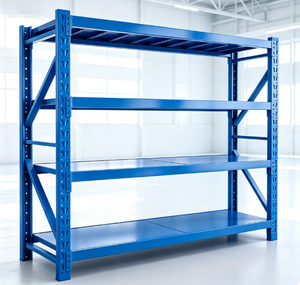
Factory Direct Boltless Heavy Duty Steel Storage Rack for Commercial & Garage Use
- Rapid Assembly Rivet/Keyhole System
- Scratch-Resistant Textured Finish
- Versatile Multi-Purpose Shelving
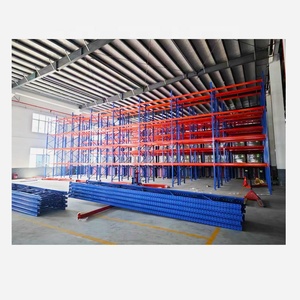
Customized Heavy Duty Warehouse Storage Pallet Racking System
- Tailored Structural CAD Layouts
- Seismic Zone Dynamic Calculations
- Turnkey OEM/ODM Global Export
Why Direct Wholesaler Sourcing Matters: Technical Architecture
Evaluating structural integrity, steel metallurgy, non-destructive testing, and certified international engineering parameters for enterprise supply chains.
Metallurgical Quality & Q235B/Q355B Steel
Industrial storage racking performance begins with raw material composition. Our manufacturing facilities source premium-grade cold-rolled carbon steel (Q235B and Q355B) featuring guaranteed yield strengths exceeding $235\text{ MPa}$ and $355\text{ MPa}$ respectively. Cold-rolling increases tensile performance while enabling tight dimensional tolerances during continuous roll-forming. This prevents structural deflection under static and dynamic loading cycles over decades of continuous operational use.
Rigid Structural Engineering & Punch Profiles
The structural stability of selective pallet racking relies on the mechanical lock between upright frame columns and horizontal box beams. Utilizing automated CNC multi-stage punching lines, column profiles feature standardized teardrop or omega shape perforations with a 50mm or 75mm pitch. Precision-engineered 3-prong or 4-prong beam connectors integrate safety locking pins to completely eliminate accidental beam dislodgement caused by forklift impact.
ABNT NBR 15524 & International Standards
Global logistics demand strict regulatory compliance. Our heavy-duty systems are calculated according to ABNT NBR 15524 (Sistemas de Armazenagem) guidelines for South American compliance (such as Brazil), alongside European FEM 10.2.02 / EN 15512 and American RMI (Rack Manufacturers Institute) frameworks. Every order includes complete structural load calculations, safety factor validations ($1.5\times \text{ safety margin}$), and Portuguese/English load warning signage.
Surface Pre-Treatment & Epoxy Coating
To resist industrial moisture, chemical vapors, and mechanical abrasion, structural components undergo a 7-stage automated chemical cleaning pre-treatment: degreasing, derusting, phosphating, and deionized water rinsing. Subsequently, an electrostatic epoxy-polyester powder coating (60–80 microns thickness) is applied and thermally cured at $180^\circ\text{C}–200^\circ\text{C}$, yielding extreme impact strength, chemical resistance, and long-term anti-corrosion protection.
Technical Comparison of Industrial Storage Systems
Select the optimal warehouse shelving architecture based on volumetric density, SKU access speed, forklift compatibility, and total cost of ownership (TCO).
| Racking Type | Storage Density | Pallet Accessibility | Standard Load Range | Typical Applications | Handling Equipment |
|---|---|---|---|---|---|
| Selective Pallet Rack | Medium (40-50%) | 100% Immediate Access | 1,000 – 4,000 kg / level | FMCG, 3PL DCs, Retail Distribution | Standard Counterbalance, Reach Trucks |
| Drive-In / Drive-Thru Rack | Very High (75-85%) | LIFO / FIFO (Lane-based) | 1,000 – 1,500 kg / pallet | Cold Storage, Beverage, Seasonal Goods | Reach Trucks, Specialized Narrow Trucks |
| Heavy Duty Long Span Shelving | High (Manual) | 100% Hand-Picked Access | 300 – 800 kg / shelf | Auto Spare Parts, Hardware, Archives | Manual Hand-Picking, Order Pickers |
| Cantilever Storage System | High (Long Items) | 100% Direct Frontal Access | 500 – 2,500 kg / arm | Steel Pipes, Lumber, Aluminum Profiles | Side Loaders, Heavy Counterbalance |
| Stacking Post Pallet Rack | Flex High (Portable) | Block Stacking Access | 1,000 – 2,000 kg / rack | Seasonal Warehousing, Agricultural Bulk | Standard Forklifts |
Future Procurement & Structural Development Trends
In-depth analysis of technological convergence, automated warehouse integration, seismic resilience, and sustainable green manufacturing in industrial rack wholesaling.
1. Convergence with AS/RS & AMR Automation
The global warehousing landscape is shifting rapidly toward automated storage and retrieval systems (AS/RS) and Autonomous Mobile Robots (AMRs). Future procurement strategies demand racking systems fabricated with sub-millimeter tolerances. Column verticality, deflection under maximum load ($L/200$ to $L/300$ ratios), and guide rail installation must strictly align with automated crane sensor tolerances to prevent mechanical jams and system downtime.
2. Dynamic Load Monitoring & IoT Sensors
Leading enterprise wholesalers are beginning to integrate smart IoT strain-gauge sensors directly into critical upright frames and load beams. These embedded sensors provide real-time telemetry regarding dynamic weight distribution, structural fatigue, beam overload warnings, and accidental forklift impact forces, enabling predictive maintenance schedules and mitigating catastrophe risk before structural failure occurs.
3. Advanced Seismic Engineering & Dissipative Baseplates
With distribution centers increasingly built in geographically active seismic zones (e.g., Pacific Rim, Latin America, Mediterranean), standard anchor bolts are insufficient. Wholesalers must provide advanced finite element analysis (FEA) modeling, ductile steel post-yield performance, and dynamic energy-dissipating baseplates designed to absorb multidirectional seismic forces during earthquake events.
4. Sustainable Green Steel & Zero-VOC Coatings
ESG compliance is becoming a critical evaluation metric for fortune-500 logistics buyers. Next-generation racking production emphasizes the utilization of electric arc furnace (EAF) green steel made with recycled scrap and renewable energy. Furthermore, solvent-free powder coatings with zero volatile organic compounds (VOCs) eliminate hazardous chemical off-gassing during manufacturing and installation.
Industrial Warehouse Racking Procurement FAQ
Detailed technical answers addressing standard buyer queries regarding load capacity, custom fabrication, international shipping, and regulatory compliance.
Request Custom Engineering Calculations & Wholesale Pricing
Consult directly with our senior structural engineers to optimize your warehouse storage layout, receive free CAD CAD space planning, and secure competitive factory-direct wholesale pricing.
Send an Inquiry